WHEN AN ENCOUNTER BECOMES SCIENCE
THE IDENTIFICATION OF A WHALE SHARK IN THE MALDIVES
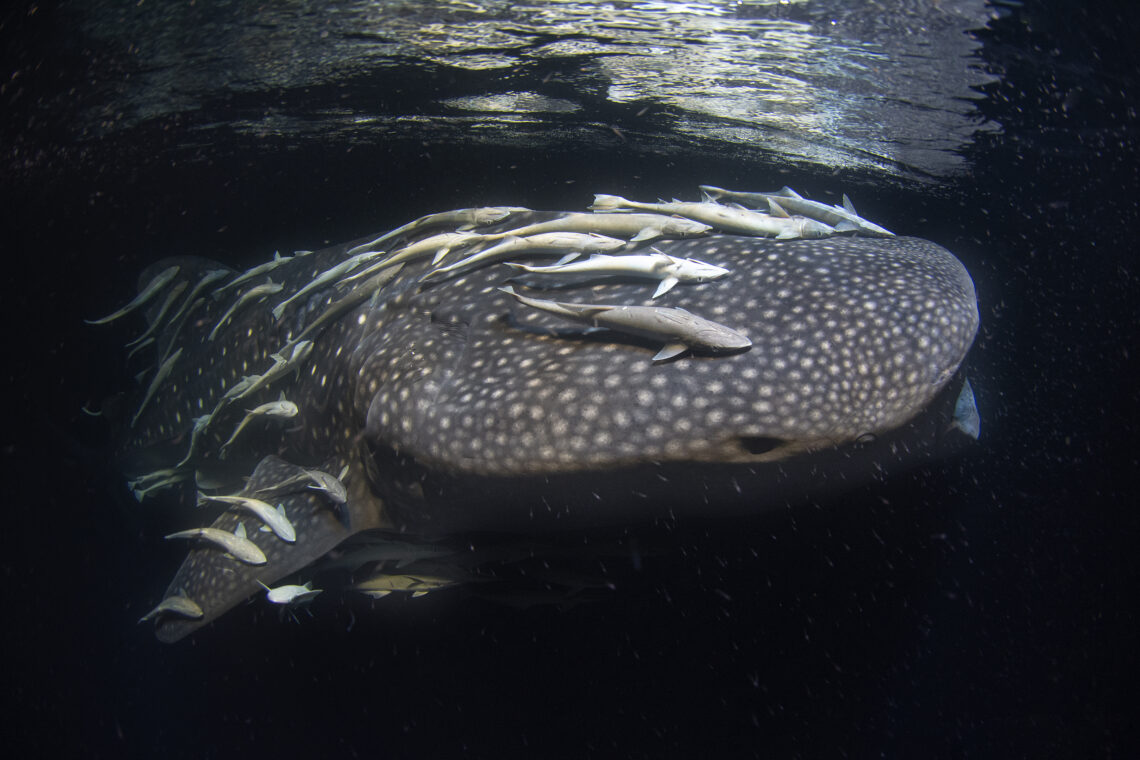
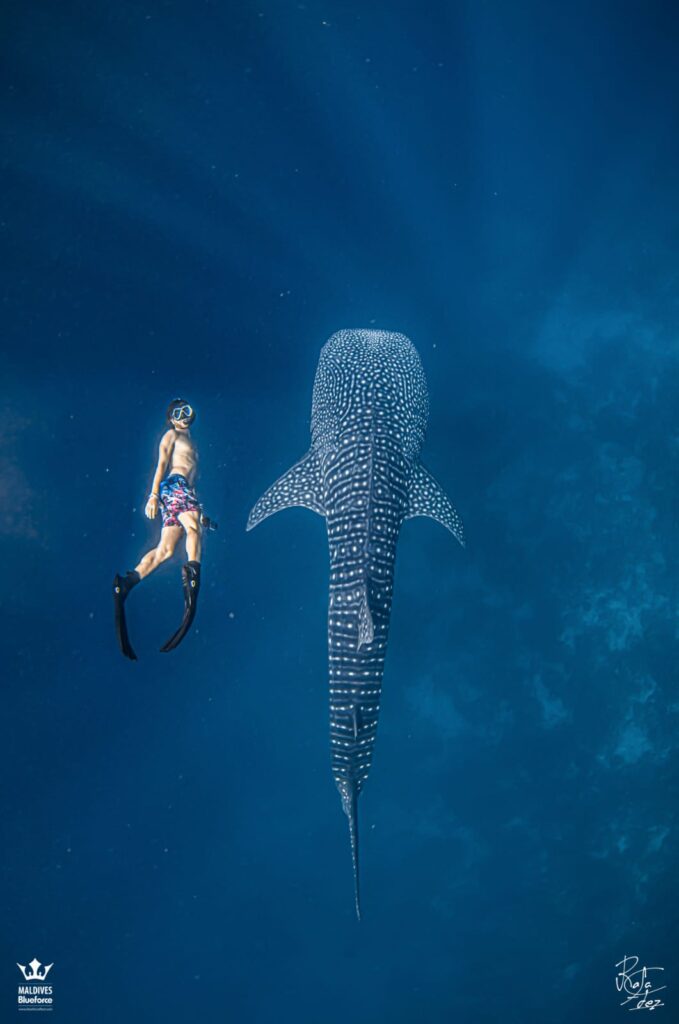
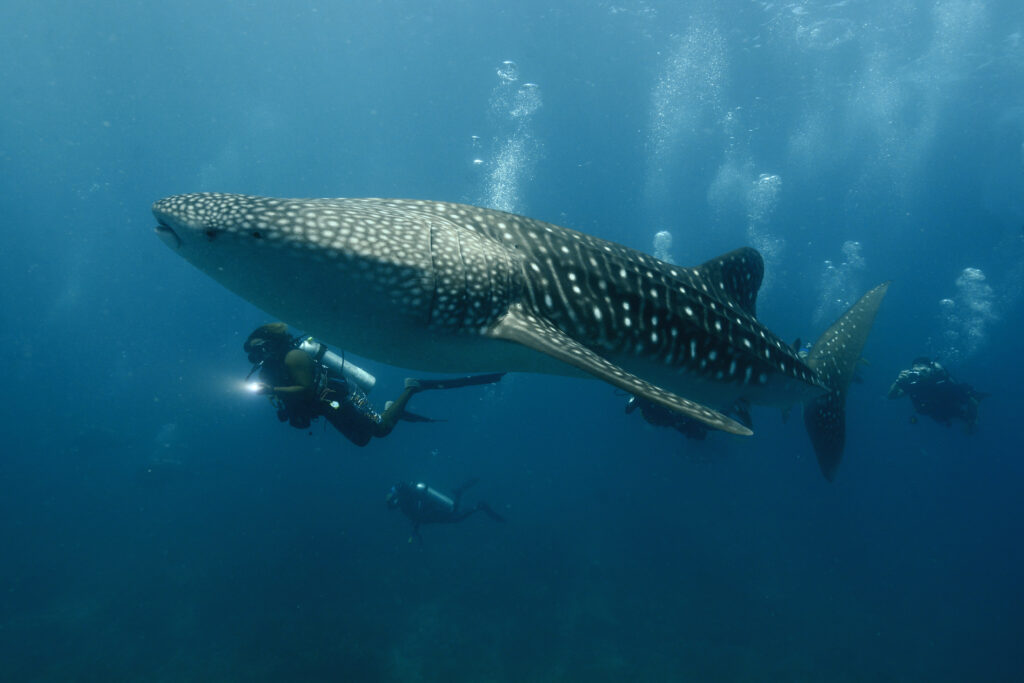
During our first trip to the southern Maldives this season, one of those encounters occurred that alone justifies an entire expedition. Underwater, in the middle of the blue, a whale shark appeared. Majestic, calm, completely indifferent to our presence.
For many divers, a moment like this would already be more than enough. But in this case, the encounter went one step further: it became an official scientific record.
What began as an unforgettable dive ended up becoming part of an international research and conservation programme.
MORE THAN A SIGHTING
Seeing a whale shark is not the same as identifying one.
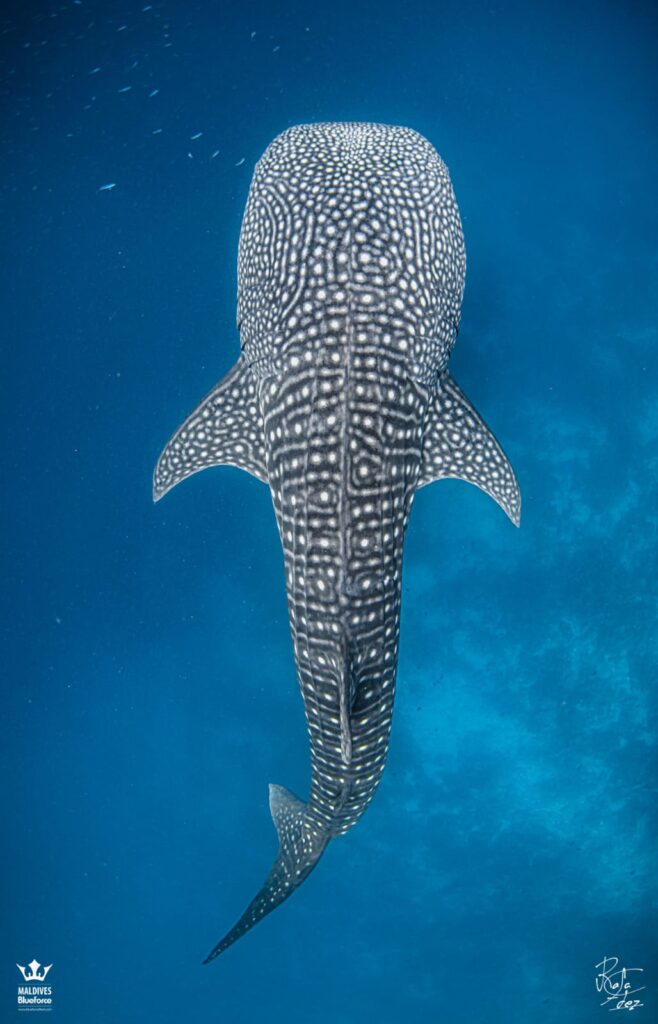
Each whale shark has a unique pattern of spots on its skin, comparable to a human fingerprint. These patterns allow researchers to distinguish each individual, track their movements over time, and gather key information about their behaviour, growth and migrations.
For a sighting to become a valid identification, it is essential to obtain clear photographs of specific areas of the animal, particularly the side where these distinctive patterns are concentrated.
In this case, thanks to a calm, respectful and well-managed encounter, it was possible to capture the images required to begin the identification process.
WHAT IS THE MALDIVES WHALE SHARK RESEARCH PROGRAMME?
The Maldives Whale Shark Research Programme (MWSRP) is one of the world’s leading organisations dedicated to the study and conservation of whale sharks in the Maldives.
For years, it has been carrying out work in the following areas:
• Scientific research
• Individual registration and identification
• Population monitoring
• Environmental education
• Promotion of responsible tourism practices
Its database makes it possible to better understand a species classified as vulnerable and to lay the foundations for its long-term protection. Without initiatives like this, much of what we know today about whale sharks would simply not exist.
MALDIVES: A UNIQUE CASE IN THE WORLD
The Maldives is one of the few — and possibly the only — destinations in the world where whale sharks can be observed naturally throughout the entire year.
Unlike other places where tourist sightings depend on feeding practices (artificial feeding), encounters in the Maldives occur without altering the species’ natural behaviour. Whale sharks come to these waters for genuine ecological reasons: food availability, favourable conditions and a relatively protected environment.
Studies conducted by the Maldives Whale Shark Research Programme also show that approximately 72% of whale sharks observed in the Maldives are juvenile males. As they have not yet reached reproductive maturity, these waters represent an ideal environment for them to feed, grow and remain protected before embarking on long oceanic migrations.
This pattern makes the Maldives an area of enormous scientific and conservation value and reinforces the importance of protecting these ecosystems and managing tourism responsibly.
To learn more about the work of this organisation and its research and conservation efforts, we recommend visiting their website: https://maldiveswhalesharkresearch.org/
FROM THE OCEAN TO THE SCIENTIFIC RECORD
The process that transforms a dive into an official identification follows several steps:
1. Sighting during the dive.
2. Capturing photographs suitable for identification.
3. Submission of images and data to the MWSRP.
4. Comparison with the existing database.
5. Confirmation that it is a new individual.
6. Assignment of an official code and name.
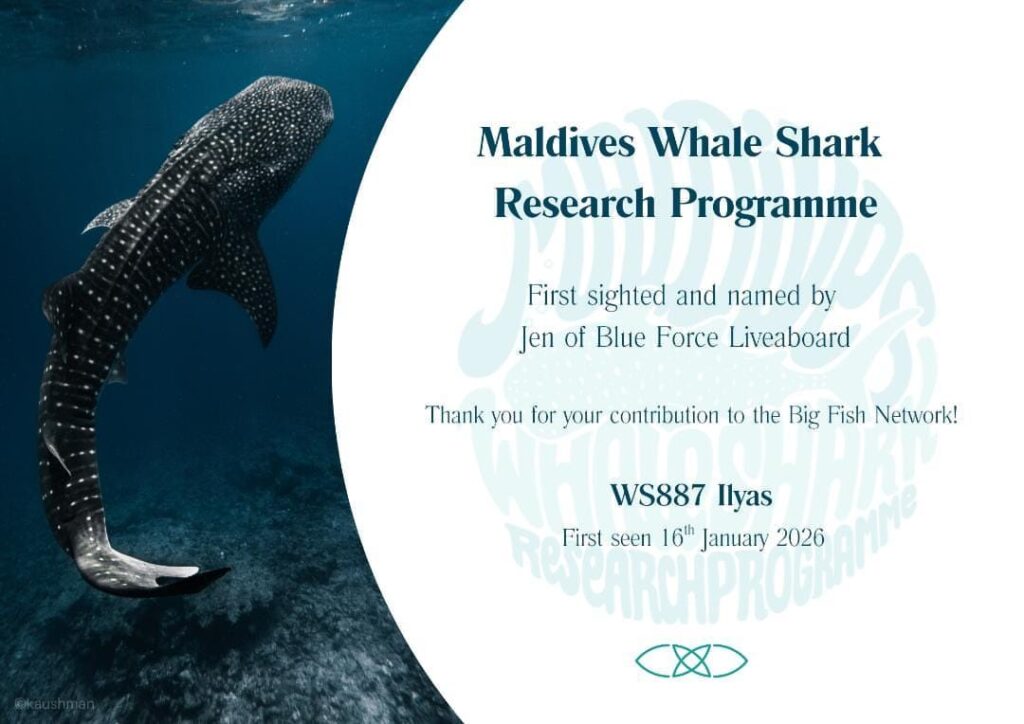
In this case, the whale shark was registered as WS887 “Ilyas”, first observed on January 16, 2026.
A unique encounter that now forms part of global scientific knowledge.
THE IMPORTANCE OF CONSERVATION PROGRAMMES
Whale sharks face real threats: maritime traffic, bycatch, human pressure and habitat degradation.
Research and conservation programmes do not only collect data. They raise awareness, influence regulations and demonstrate that tourism, when responsibly managed, can become a positive tool for species protection.
Every identification adds value. Every data point matters.
BLUE FORCE FLEET’S COMMITMENT
At Blue Force Fleet, we understand diving as much more than a recreational activity. We are committed to a model of responsible tourism that respects the environment and actively supports marine conservation.
For this reason:
• We actively collaborate with scientific programmes
• We train our crews in best practices
• We strictly respect codes of conduct during sightings
• We promote awareness among our guests
Our trips aim not only to offer extraordinary experiences, but also to leave a positive footprint on the destinations we visit.
WHEN TRAVELLING ALSO MEANS CONTRIBUTING
Identifying a whale shark is not just an anecdote. It is a way of contributing knowledge, of giving value to an encounter, and of understanding that every dive can go beyond the personal experience.
The ocean gives us unforgettable moments. Our responsibility is knowing how to give something back.
Thus, dive by dive and journey by journey, diving also becomes conservation.
Jesús Arto


You May Also Like
THE NORTHERN MALDIVES
Why do two people do the same route in Maldives and have completely different experiences?